House training is mostly about prevention and timing. If you take your puppy out at the right moments and reward them for going outside, they learn quickly.
When to take your puppy out
- First thing in the morning and last thing at night
- Within minutes after eating or drinking
- After naps and play sessions
- Every 1–2 hours for young puppies
Reward at the right moment
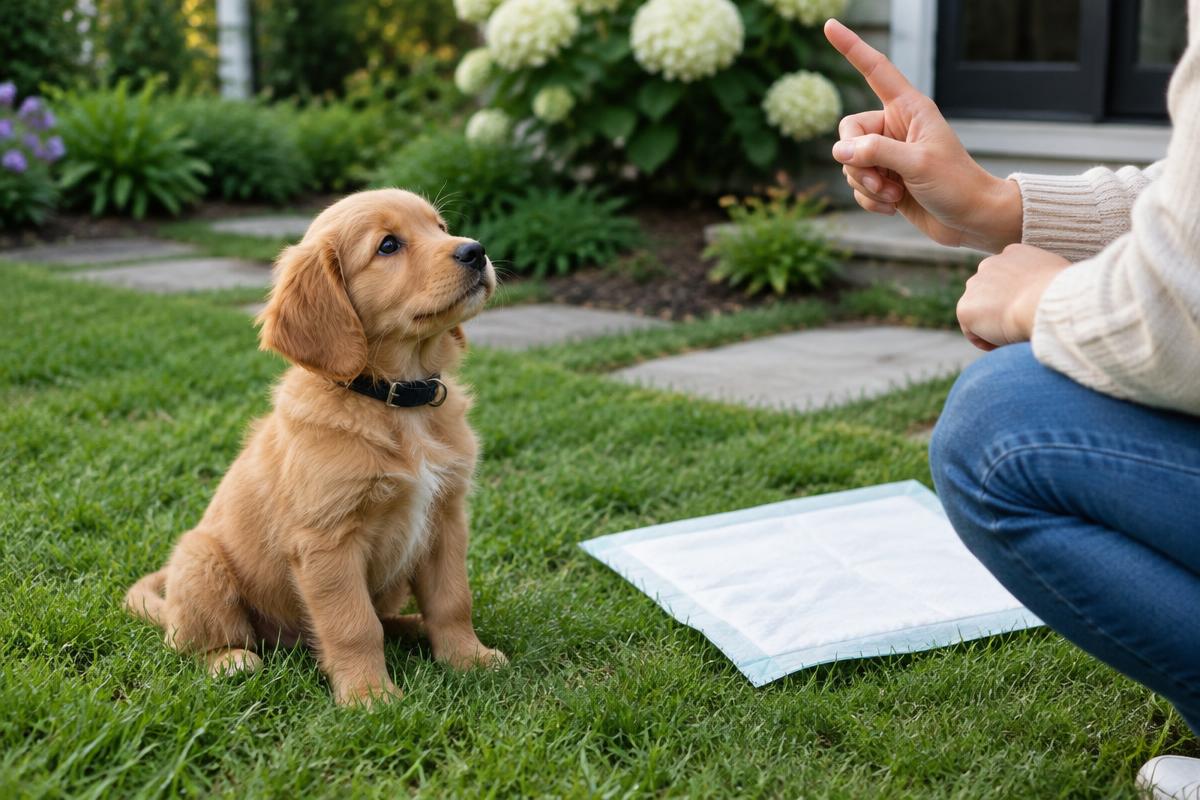
Go to the same spot, stay calm, and the moment your puppy finishes, praise and give a tasty treat right there. Rewarding back indoors is too late for them to make the connection.
Handling accidents
If you catch your puppy mid-accident, calmly interrupt and take them outside. Never scold after the fact — it teaches puppies to hide from you, not to go outside. Clean with an enzymatic cleaner to remove the scent.
How long can a puppy hold it?
A common rule of thumb is that a puppy can hold its bladder for roughly one hour per month of age, plus one, during the day. A three-month-old puppy may manage around three to four hours at the very most, and often less when it is awake and playing. Treat this as a ceiling, not a target: if you wait until the limit, you are setting the puppy up for accidents.
Activity changes everything. Play, excitement, drinking and eating all speed up the need to go. A puppy that slept quietly for three hours overnight may need to go out within fifteen minutes of a wrestling session in the living room. Watch the puppy rather than the clock, and use the clock as a backup reminder.
Overnight, most young puppies need one trip out in the early hours for the first few weeks. Keep that trip boring: no play, minimal talking, dim lights, and straight back to bed. This teaches the puppy that night-time is for sleeping, and the overnight trip usually disappears on its own as bladder control improves.
A sample daily schedule
Consistency is the single biggest factor in fast house training. A predictable routine means your puppy's body learns when to expect a toilet break, and you learn when accidents are most likely. The schedule below is a starting point for a puppy of around ten to sixteen weeks; adjust it to your household.
- 6:30 — Wake up and go straight outside, carrying a small puppy if needed so it doesn't stop on the way.
- 7:00 — Breakfast, then outside again within 10–20 minutes.
- 7:30–9:00 — Supervised play and short training sessions, with a toilet break every 45–60 minutes.
- 9:00 — Toilet break, then a nap in the crate or pen.
- After every nap — Outside immediately.
- 12:00 — Lunch (for puppies on three meals a day) followed by a toilet break.
- Afternoon — Repeat the cycle of play, toilet, nap.
- 17:30 — Dinner, then outside.
- Evening — Calm time with regular breaks; pick up the water bowl an hour or two before bed if your vet agrees.
- 22:30 — Last toilet break, then bed.
Choosing and using a toilet spot
Pick one spot outside and take your puppy there on a leash every time. Dogs are drawn to places that smell like they have been used before, so a consistent spot quickly becomes a cue in itself. Stand still, stay quiet and let the puppy sniff. Walking around and chatting turns the trip into a playtime and delays the actual business.
Add a cue word such as "go potty" just as your puppy starts to squat. After a few weeks of pairing the word with the action, many dogs will go on cue, which is extremely helpful before car trips, vet visits or bedtime.
If the puppy has not gone after about five minutes, bring it back inside and keep it close or in its crate for ten to fifteen minutes, then try again. This avoids the classic situation where a puppy plays outside for twenty minutes and then relieves itself on the kitchen floor.
Supervision, crates and pens
Every accident you don't see is a missed opportunity to teach. During the training period your puppy should either be directly supervised, confined in a safe space, or outside with you. Baby gates, a tether attached to your belt, or a play pen all help you keep eyes on the puppy without following it around the house.
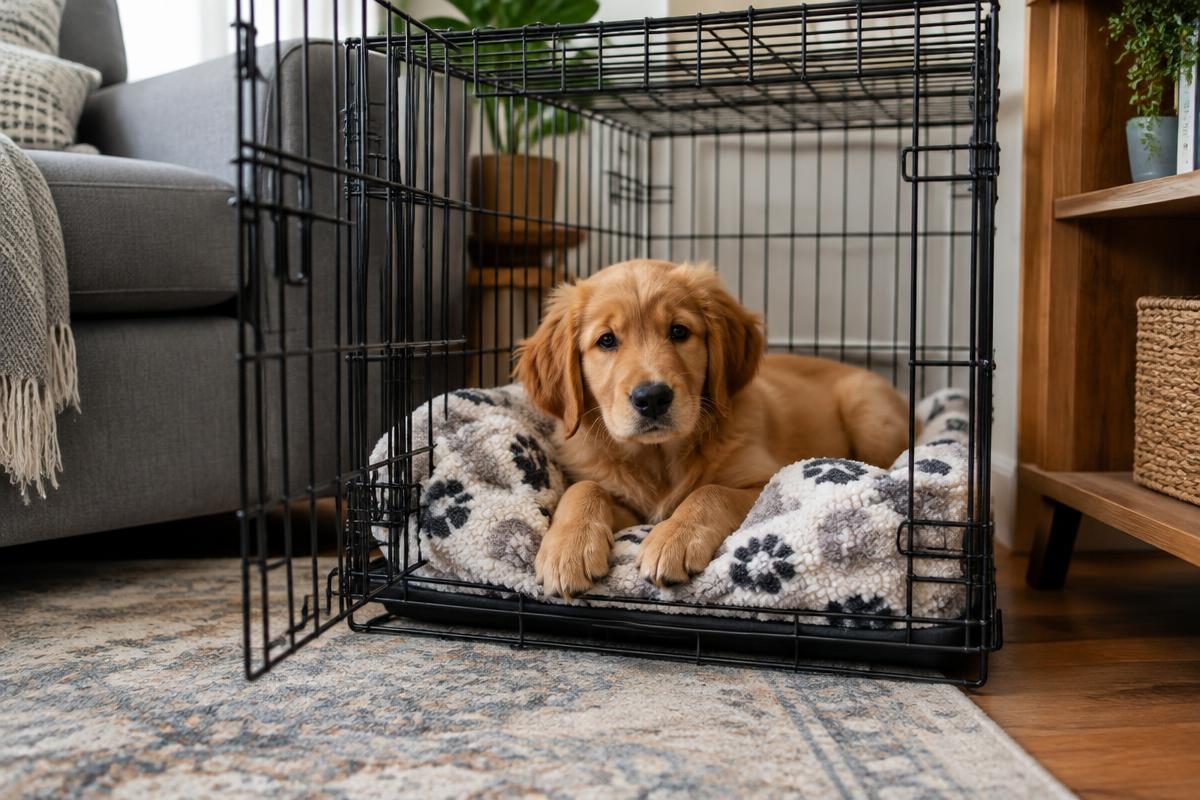
Crates work because most dogs avoid soiling where they sleep. The crate should be just large enough for the puppy to stand, turn around and lie down; a crate that is too big leaves room for a toilet corner. Many crates come with a divider so you can enlarge the space as the puppy grows.
Never use the crate as punishment and don't leave a young puppy confined for longer than it can physically hold its bladder. If you work long hours, arrange a midday visit from a family member, neighbour or dog walker during the first months.
Cleaning up properly
Ordinary household cleaners often remove the visible mess but leave odour molecules that your puppy can still smell, which invites repeat accidents in the same spot. Use an enzymatic cleaner made for pet urine, which breaks down the compounds that cause the smell.
Avoid ammonia-based products. Urine contains ammonia, so these cleaners can make the area smell even more like a toilet to a dog. Blot up as much liquid as possible first, apply the enzyme cleaner generously, and let it work for the time recommended on the label.
Common mistakes that slow progress
Most house-training problems come from a few predictable mistakes. Fixing them usually produces fast improvement.
- Giving too much freedom too soon — expand access to the house one room at a time, only after weeks without accidents.
- Punishing accidents — scolding teaches a puppy to hide when it needs to go, not to go outside.
- Rewarding too late — praise and treat within two seconds of the puppy finishing, while you are still outside.
- Inconsistent routines — different family members using different spots, words or schedules confuses the puppy.
- Relying on pee pads indefinitely — pads can teach that indoor surfaces are acceptable, making the switch outdoors harder.
- Assuming it's done — many dogs regress around adolescence or after moving house; keep the routine for a while after success.
When to talk to your vet
Sometimes accidents are a medical problem rather than a training one. Urinary tract infections, intestinal parasites, diet changes and some congenital conditions can all cause frequent or urgent toileting. A puppy that was making good progress and suddenly starts having accidents deserves a check-up.
Contact your veterinarian if you notice straining, blood in the urine or stool, very frequent small amounts of urine, diarrhoea lasting more than a day, excessive thirst, or a puppy that seems to dribble urine without realising. Ruling out a medical cause first saves weeks of frustrating training that could never have worked.
Frequently asked questions
How long does house training take?
Many puppies are reliable by 4–6 months, but some take up to a year. Small breeds often take longer.
Should I use pee pads?
Pee pads can help in high-rise apartments or for very young puppies, but they can slow outdoor training. If you use them, keep them in one spot and gradually move them toward the door.
Why does my puppy pee when excited?
Excitement or submissive urination is common in young puppies. Keep greetings calm and low-key; most puppies grow out of it. Mention it to your vet if it continues past adolescence.
My puppy goes right after coming inside. Why?
Usually the trip outside was too short or too exciting. Stay outside longer, stay quiet and boring, and return inside only after the puppy has gone.
Key takeaways
- Timing and supervision prevent most accidents.
- Reward outdoors, immediately.
- Punishment slows house training.
- Use the 'months plus one' bladder rule as a maximum, not a goal.
- A fixed daily schedule and a single outdoor spot speed everything up.
- Clean accidents with an enzymatic cleaner, never ammonia.
- Sudden regression can be medical — check with your vet.
This guide is for general information and doesn't replace advice from your veterinarian. If your dog seems unwell, contact your vet. Read our disclaimer.
Sources
Pawly Editorial Team
Pet care writers & editors
Pawly's articles are written and edited by our editorial team of experienced dog owners and pet-care writers. Every guide is built from published veterinary guidance — from organizations such as the AVMA, AAHA, WSAVA and the ASPCA — and is reviewed for accuracy before publishing and regularly after.
More from our writers →